
00
DAYS TO GO DAY
00
hours hour
00
minutes minute
00
seconds second
DAYS TO GO DAY
hours hour
minutes minute
seconds second
Wander through the charming old town quarters of Kraków, Warsaw, Toruń, and Zamość, where history comes alive. Dive into the depths of unique underground marvels like the Royal Salt Mines in Wieliczka and Bochnia or the Lead-Silver-Zinc Mine in Tarnowskie Góry. Explore the rich stories captured within the exquisite religious structures, including the captivating Kalwaria Zebrzydowska and the serene Wooden Churches of Southern Małopolska.
Marvel at the architectural splendor of the Castle of the Teutonic Order in Malbork or take a leisurely stroll through the lush Muskauer Park. Don’t miss the stunning contemporary gem, the Centennial Hall in Wrocław.
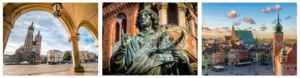
Old Town of Kraków, Medieval Urban Complex of Toruń, Old Town in Warsaw
And for nature lovers, the Białowieża Forest, a majestic primeval landscape, along with the Ancient and Primeval Beech Forests of the Carpathians, offer breathtaking beauty and serenity. Poland’s UNESCO treasures await—come and discover the wonders that make our heritage truly unforgettable.
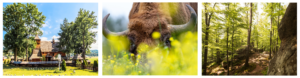
Wooden Churches of Southern Lesser Poland, Białowieża Forest, Ancient and Primeval Beech Forests of the Carpathians
The Old Town of Kraków, designated as one of the first 12 UNESCO World Heritage Sites in 1978, is widely regarded as a cultural and historical heart of Poland. The area encompasses the medieval city within its former defensive walls – once protected by the iconic Barbican and Florian Gate – as well as Wawel Hill with the Royal Castle and Cathedral, and the historic districts of Kazimierz and Stradom.
Its vast collection of Gothic, Renaissance, and Baroque monuments reflects over a millennium of urban development. The Main Market Square, Europe’s largest medieval square, is home to the Cloth Hall (Sukiennice), St. Mary’s Basilica, and numerous townhouses belonging to Kraków’s merchant elite. The Old Town is also a vibrant cultural center, hosting the Jagiellonian University – one of Europe’s oldest – and preserving countless artistic masterpieces and archives central to Polish identity.
The Wieliczka Salt Mine, a UNESCO site since 1978, and the Bochnia Salt Mine, added to the listing in 2013, together form the Royal Salt Mines – one of the world’s oldest continuously operating industrial sites. Salt extraction began here in the Middle Ages and remained a backbone of the Polish economy for centuries.
Visitors today can explore underground chapels carved entirely out of salt, including the breathtaking Chapel of St. Kinga in Wieliczka, subterranean lakes, and historic mining machinery. The mines also offer therapeutic chambers with a health-promoting microclimate used for respiratory treatments. The network of tunnels stretches for hundreds of kilometers, illustrating centuries of mining innovation and human effort.
Auschwitz-Birkenau, inscribed on the UNESCO list as a memorial site, stands as one of the most powerful symbols of the Holocaust. Established by Nazi Germany in 1940 in occupied Poland, the complex comprised Auschwitz I (the administrative center) and Auschwitz II–Birkenau (the primary extermination camp), located 3.5 km apart.
More than 1.1 million people – mostly Jews – were murdered here. The preserved barracks, ruins of gas chambers, personal belongings of victims, and extensive documentation serve as a stark reminder of the systematic brutality of the Nazi regime. The Auschwitz-Birkenau State Museum ensures ongoing educational work and commemoration, attracting millions of visitors seeking historical understanding and reflection.
Inscribed in 1979, Białowieża Forest is one of the last remaining fragments of the immense primeval woodland that once covered much of Europe. Shared by Poland and Belarus, this ancient ecosystem features trees over 500 years old and supports exceptional biodiversity.
It is the refuge of the European bison, the continent’s largest land mammal, which was successfully reintroduced after near-extinction in the early 20th century. The forest offers a rare glimpse into a natural environment shaped solely by natural processes, making it invaluable for scientific research in ecology and conservation.
Added to the UNESCO list in 1980, the Old Town in Warsaw is globally recognized as a symbol of reconstruction on an unprecedented scale. Completely destroyed by the Nazis after the 1944 Warsaw Uprising, it was meticulously rebuilt in the post-war years using traditional methods and detailed historical sources – including 18th-century vedute by Canaletto.
The restored urban landscape includes the Royal Castle, the Barbican, St. John’s Archcathedral, and narrow streets leading to the Old Town Market Square. This reconstruction represents not only architectural revival but also cultural resilience and the determination of Warsaw’s citizens to restore their heritage.
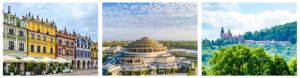
Old Town in Zamość, Centennial Hall in Wrocław, Kalwaria Zebrzydowska
Inscribed in 1992, the Old Town of Zamość is a rare example of an ideal Renaissance city preserved almost intact. Designed in the late 16th century by Italian architect Bernardo Morando for Chancellor Jan Zamoyski, the city features a regular grid layout, fortress walls, spacious market squares, and harmonious urban architecture combining Italian and Central European influences. Its grand Town Hall, arcaded tenement houses, and cathedrals reflect Zamość’s vision as a “Padua of the North” and a thriving multicultural hub.
Designated in 1997, Toruń’s medieval urban complex represents one of the most authentic examples of Gothic architecture in Europe. Founded by the Teutonic Order in the 13th century, the city played a vital role in trade on the Hanseatic Route and is the birthplace of the astronomer Nicolaus Copernicus. Its preserved granaries, townhouses, and monumental churches reflect the wealth of a medieval merchant city. The celebrated panorama from the Vistula River, especially illuminated at dusk, is recognized as one of Poland’s most iconic views.
Malbork Castle, added to the UNESCO list in 1997, is the largest brick castle in the world and one of the finest examples of medieval fortification architecture. Constructed in the 13th and 14th centuries as the headquarters of the Teutonic Order, it consists of three interconnected castles forming an extensive defensive complex.
Visitors can explore grand halls, the High Castle, a vast refectory, and intricately decorated interiors. The castle’s riverside setting on the Nogat enhances its monumental presence, making it a highlight of Gothic architecture in Europe.
Inscribed in 1999, Kalwaria Zebrzydowska is an exceptional Mannerist complex combining architecture, landscape design, and religious devotion. Founded in the early 17th century, it consists of a basilica, monastery, and over 40 chapels connected by pilgrimage routes that replicate the landscapes of Jerusalem.
Spanning six square kilometers, it attracts both pilgrims and visitors interested in its harmonious blend of spiritual symbolism and natural scenery. The site also holds significance for Pope John Paul II, who visited frequently during his youth.
Added in 2001, the Churches of Peace are the largest timber-framed religious structures in Europe. Built in the mid-17th century under strict conditions imposed after the Peace of Westphalia – such as limited construction time and use of non-durable materials – the churches are architectural marvels of ingenuity.
Their interiors contrast sharply with the sobriety of their exteriors, featuring elaborate Baroque altars, galleries, and pulpit decorations. They also serve as venues for acclaimed organ and classical music concerts.
Since 2003, six wooden Gothic and Baroque churches of Małopolska have been recognized as UNESCO sites. Dating from the 15th to 18th centuries, they reflect traditional carpentry techniques using horizontal log construction. Adorned with polychrome interiors, carved altars, and shingled roofs, these churches form a unique architectural route across the region, illustrating centuries of religious and artistic traditions.
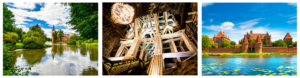
Muskauer Park, Royal Salt Mines in Wieliczka, Castle of the Teutonic Order in Malbork
Designated in 2004, Muskauer Park is a cross-border cultural landscape shaped in the early 19th century by Prince Hermann von Pückler-Muskau. Spanning 700 hectares in Poland and Germany, it is one of Europe’s largest and most influential English-style landscape parks. The design emphasizes harmony between natural scenery and human-made elements such as bridges, viewpoints, and the New Castle, creating a picturesque environment that inspired landscape architecture across Europe.
Added in 2006, the Centennial Hall is a groundbreaking example of early 20th-century engineering. Designed by Max Berg and completed in 1913, it features an enormous reinforced-concrete dome – the largest of its kind at the time – spanning 65 meters. The hall, surrounded by a historic exhibition complex and Pergola garden, continues to serve as a major venue for cultural, sporting, and academic events, symbolizing the innovation of modern architecture.
Inscribed in 2013, the wooden tserkvas (Orthodox and Greek Catholic churches) of Poland and Ukraine embody centuries of Eastern Christian building traditions. Their characteristic log construction, multi-domed silhouettes, and intricately decorated interiors demonstrate a unique fusion of Byzantine liturgical forms with Carpathian craftsmanship. These structures, set among mountain landscapes, represent the architectural heritage of communities that once thrived in this multicultural region.
Recognized in 2017, the mine and its extensive underground water management system reflect innovative mining techniques developed from the 16th century onward. The system of engineered channels and drainage tunnels enabled efficient extraction of lead, silver, and zinc ores. Today, visitors can explore underground passages, pumping stations, and exhibitions that reveal the technological advancements that made the region a major European mining center.
Added in 2019, the Krzemionki complex is one of the world’s best-preserved prehistoric flint mining regions, dating from around 3900-1600 BCE. Its underground corridors and extraction pits reveal advanced mining methods used by Neolithic communities to produce flint axes – widely traded tools of the time. The surrounding landscape includes remnants of ancient settlements, offering insight into early human industry and social organization.
Inscribed in 2021 as part of a multi-national serial site, the Ancient Beech Forests of the Carpathians represent pristine ecosystems shaped by natural evolutionary processes over thousands of years. Located in the remote Bieszczady Mountains, these forests provide a refuge for rare wildlife and a living laboratory for studying forest dynamics unaffected by human intervention. Their ecological purity makes them one of Europe’s most valuable natural heritage areas.
Found more at poland.travel